Coursera

Spatial Analysis, 3D Data & Machine Learning

Ends soon: Grow your skills with Coursera Plus for $239/year (usually $399). Save now.

Coursera

Spatial Analysis, 3D Data & Machine Learning

Coursera

Instructor: Coursera

Included with Coursera Plus

Gain insight into a topic and learn the fundamentals.
Beginner level

Recommended experience

1 week to complete
at 10 hours a week
Flexible schedule
Learn at your own pace
Gain insight into a topic and learn the fundamentals.
Beginner level

Recommended experience

1 week to complete
at 10 hours a week
Flexible schedule
Learn at your own pace

What you'll learn

  • Apply spatial statistics and interpolation techniques

  • Work with LiDAR and 3D geospatial data

  • Train machine learning models on geospatial datasets

  • Use deep learning for imagery classification

Details to know

Shareable certificate

Add to your LinkedIn profile

Recently updated!

April 2026

Assessments

23 assignments¹

AI Graded see disclaimer
Taught in English

See how employees at top companies are mastering in-demand skills

 logos of Petrobras, TATA, Danone, Capgemini, P&G and L'Oreal

Build your subject-matter expertise

This course is part of the Mastering Geospatial Data Science: From Beginner to Expert Specialization
When you enroll in this course, you'll also be enrolled in this Specialization.
  • Learn new concepts from industry experts
  • Gain a foundational understanding of a subject or tool
  • Develop job-relevant skills with hands-on projects
  • Earn a shareable career certificate

There are 13 modules in this course

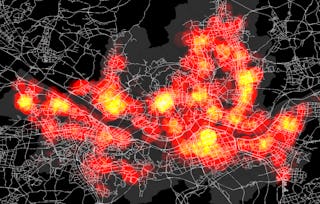
In this module, you will explore how spatial patterns differ from random distributions and why that difference matters in real-world analysis. Using air-quality sensor data as a motivating example, you will examine how Global Moran’s I quantifies spatial autocorrelation in polygon data and helps analysts identify clustering patterns that might otherwise go unnoticed.

What's included

1 video1 reading2 assignments

In this module, you will examine how spatial analysts estimate values between discrete measurement locations. Using air-quality sensor data as a motivating example, you will be introduced to Inverse Distance Weighting (IDW) interpolation and learn how distance-based assumptions are used to generate continuous surfaces from point observations. You will explore how parameter choices influence interpolation results and learn how to interpret estimated surfaces responsibly in real-world spatial analysis contexts.

What's included

2 videos1 reading2 assignments

In this module, you will step back from computation to interpretation, focusing on semivariograms as diagnostic tools for spatial structure. By learning how to read range, sill, and nugget, you will gain intuition about spatial dependence, knowledge that informs both analysis choices and communication with non-technical audiences.

What's included

2 videos1 reading2 assignments

Learners understand what LiDAR point clouds represent and can confidently load and explore them in a 3D environment.

What's included

1 video2 readings1 assignment

Learners understand why DEMs are derived products and can create one correctly from ground-class LiDAR points.

What's included

1 video2 readings2 assignments

Learners evaluate whether a DEM is fit for purpose by comparing it against known reference elevations.

What's included

1 video2 readings2 assignments

You will explore why raw imagery alone is insufficient for supervised classification and how engineered features improve model performance. The lesson focuses on practical extraction of spectral bands and texture metrics used in land-cover analysis.

What's included

1 video2 readings2 assignments

You will apply engineered features to train a Random Forest classifier. Emphasis is placed on intuition: how trees vote, how parameters affect performance, and how to avoid beginner mistakes.

What's included

1 video2 readings2 assignments

You will evaluate whether the model meets job requirements by interpreting confusion matrices and accuracy metrics. The lesson emphasizes decision-making, not just calculation.

What's included

1 video2 readings2 assignments

In this module, you will apply transfer learning techniques to fine-tune a pre-trained convolutional neural network (CNN) for land cover classification using satellite imagery. The module focuses on adapting existing vision models to geospatial data under real-world constraints such as limited labeled samples, class imbalance, and spatial generalization challenges.

What's included

1 video2 readings2 assignments

In this module, learners design and apply data augmentation pipelines to improve the generalization of convolutional neural networks trained on satellite imagery. The module focuses on selecting realistic augmentations that preserve spatial meaning while addressing limited and imbalanced land-cover data.

What's included

2 videos2 readings1 assignment

In this module, learners use Grad-CAM visualizations to interpret convolutional neural network predictions for satellite imagery. The module emphasizes understanding model attention, identifying failure modes, and communicating model behavior clearly to technical and non-technical stakeholders.

What's included

1 video2 readings2 assignments

In this project, you will build a geospatial machine learning workflow to classify land cover using imagery, LiDAR-derived elevation data, and labeled samples. You will engineer features, train a model, validate the results, and generate a classified land cover output. You will also summarize model performance and create an interpretation output to explain how the model behaves. This project requires learners to demonstrate spatial analysis, 3D data use, machine learning implementation, validation, interpretation, and stakeholder communication in one authentic workflow.

What's included

2 readings1 assignment

Earn a career certificate

Add this credential to your LinkedIn profile, resume, or CV. Share it on social media and in your performance review.

Instructor

Coursera
19 Courses3,242 learners

Offered by

Coursera

Explore more from Machine Learning

Why people choose Coursera for their career

Felipe M.

Learner since 2018
"To be able to take courses at my own pace and rhythm has been an amazing experience. I can learn whenever it fits my schedule and mood."

Jennifer J.

Learner since 2020
"I directly applied the concepts and skills I learned from my courses to an exciting new project at work."

Larry W.

Learner since 2021
"When I need courses on topics that my university doesn't offer, Coursera is one of the best places to go."

Chaitanya A.

"Learning isn't just about being better at your job: it's so much more than that. Coursera allows me to learn without limits."
Coursera Plus

Open new doors with Coursera Plus

Unlimited access to 10,000+ world-class courses, hands-on projects, and job-ready certificate programs - all included in your subscription

Advance your career with an online degree

Earn a degree from world-class universities - 100% online


Join over 3,400 global companies that choose Coursera for Business

Upskill your employees to excel in the digital economy

Frequently asked questions

¹ Some assignments in this course are AI-graded. For these assignments, your data will be used in accordance with Coursera's Privacy Notice.