AL
5.0Reviewed Oct 30, 2024
Focuses on the environment, but neglects economy and society.
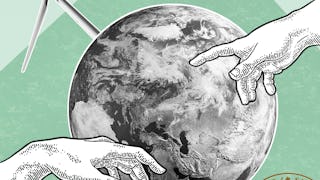
In this course, participants are introduced to key notions and concepts evolving in sustainability science that are relevant to all, independent to one's work or field of interest. After having completed the course, participants will have a better understanding of the vocabulary used today and should demonstrate the ability to reflect critically to integrate different perspectives of environmental, social, and economic sustainability to their specific area of interest or research. Throughout the course, links are made to the Agenda 2030 for Sustainable Development, as our current global road map towards sustainability, and how new approaches and solutions are emerging to describe, understand and address key sustainability challenges. Put simply, the overall aim is to give participants the knowledge and confidence needed to present and discuss ideas with others by applying methods, concepts and the vocabulary exemplified in the course with a more holistic view on the sustainability agenda across topics and disciplines. The course is designed as 5 modules: The first module presents essential concepts within sustainability science, and methods used to describe, frame, and communicate aspects of sustainability. We look at key questions such as what we mean with strong or weak sustainability, resilience, tipping points and the notion of planetary boundaries. We also look at some techniques used of envisioning alternative futures and transitions pathways. The second module is all about systems thinking and how systemic approaches are applied today to achieve long-term sustainability goals. Your will see what we mean with systems thinking and how systems thinking, and design is applied in practice to find new solutions. The third module touches upon drivers for a sustainable future, namely links to economy and business with an introduction to notions of a circular economy, and also policy and regulatory frameworks. We introduce the basics of transformative policy frames and how they are designed and applied through several real-case examples. The fourth module discusses the links between innovation and sustainability, highlighting approaches for technological, social, institutional, and financial innovations. Some examples (or cases) aim to show how different actors across society balance in practice the need for innovative approaches for social, environmental, and economic sustainability. The fifth and last module provides general insights on how we work with models to create various scenarios that help us identify solutions and pathways for a more sustainable world. Three main dimensions are addressed namely climate and climate change, nature and biodiversity, and the importance of data and geodata science to support spatial planning and sustainable land use. This course is brought to you by Lund University with input from four external contributors: - Lund Municipality, Sweden - DigIT Hub, a cluster organisation for digitalisation in society based in Lund, Sweden - Forum for Social Innovation Sweden, a national network across 5 universities - Sustainable Business Hub, a cluster organisation for smart sustainable cities, based in Malmö, Sweden
AL
Focuses on the environment, but neglects economy and society.
CV
Great varied and comprehensive content - struggled a bit with the spoken English.
NM
This course was easy to follow and interesting enough to keep me engaged.
SS
very helpful!! well paced and great information and lecturers.
MD
A very systematic course on concept and approaches for sustainable future. I would suggest everyone to pursue this course for better understanding of sustainability.
HT
Absolutely fantastic course, and super informative. The Lectures are enjoyable and eye-opening.
NS
Great for beginners. Concepts and terminology well explained. Good reading material with case studies.
AR
It helped me to understand the environmental jargon and I am extremely happy the way course was organized. Thanks a lot Lund university and co.
MK
Exceptional learning, teaching was too explanatory and comprehensive.
MA
Excellent course. Helpful for HSE Professionals in renewable enrgy sector
KT
I sincerely appreciate the invaluable course you provided. I thoroughly enjoyed every aspect of it and gained a wealth of knowledge.
EM
Excelent Course to understand the concepts, as a beginner in the sustainable world that we need.
Showing: 20 of 39
This course was easy to follow and interesting enough to keep me engaged.
very informative
The course picks a few aspects around sustainability, but should be studied together with other courses to get a full overview. E.g. the course from Lund about circularity that gives much mnore practical and ready to use examples of moving towards a sustainable future.
Overall, I liked the course. Some lectures, I felt, where not evidence-based. They had an ideological content that I disliked.
Dear Coursera and Lund University, Pls accept my heartfelt appreciation for the "Working for a Sustainable Future: Concepts and Approaches" course. The facilitators' dedication and expertise were evident throughout, making the learning experience both enriching and inspiring. The Videos, reading materials and references were top class. In today's world, understanding sustainability and the Sustainable Development Goals (SDGs) is crucial. This course provided essential knowledge and insights, highlighting the urgent need for action. Thank you for offering such a valuable learning opportunity. I am grateful for the skills gained and motivated to contribute to a more sustainable future. Best wishes Nooruddin Tejani nooruddin.tejani@aku.edu
Really insightful, diverse course offering ample information about many very important subjects relate to sustainability. It does not only inform about the theoretical framework and concepts of sustainability but best current practices that function and have sparked the change. One of the most useful parts definitely was the critical thinking approaches to teach different and more well-informed ways to think about the solutions and how to analyse them.
I chose this course to learn more about sustainability while studying City and Regional Planning. And I am very satisfied with the results. I was very happy to be asked about our thoughts on the subject in the lecture videos and to be able to participate in the course in this way. Therefore, I would like to thank the lecturers.
A great foundational course on the notion of sustainable development and key components, climate change, biodiversity, and how radical innovation is required to meet the many sustainability challenges we face.
I really enjoyed the course and its outline. It was also very easy to understand for someone who is new in the field as a result of one's interest in sustainability. Great course, highly recommended!!!
Good methodology and materials. Up to date. Interesting and easy to follow the course.
Attention! For those who may need it, the certificate does not indicate the workload hours!
Very interesting and I learn new things in each video. And now I understand some acronyms that I read and hear in some texts or lectures and that we see on TV or on the news.
A very systematic course on concept and approaches for sustainable future. I would suggest everyone to pursue this course for better understanding of sustainability.
It helped me to understand the environmental jargon and I am extremely happy the way course was organized. Thanks a lot Lund university and co.
Content is great and is a good introduction to sustainability. Only the lighting of the videos is bad and sometimes the audio.
Excelent Course to understand the concepts, as a beginner in the sustainable world that we need.
Absolutely fantastic course, and super informative. The Lectures are enjoyable and eye-opening.
A wonderful course which provides some fundamental knowledge about sustainability to us.
Excellent course. Helpful for HSE Professionals in renewable enrgy sector
An excellent course. My heartfelt thanks to Lund University and Coursera.
Exceptional learning, teaching was too explanatory and comprehensive.